


Asbestos: History, Mineralogy, Applications, and Global Health Implications
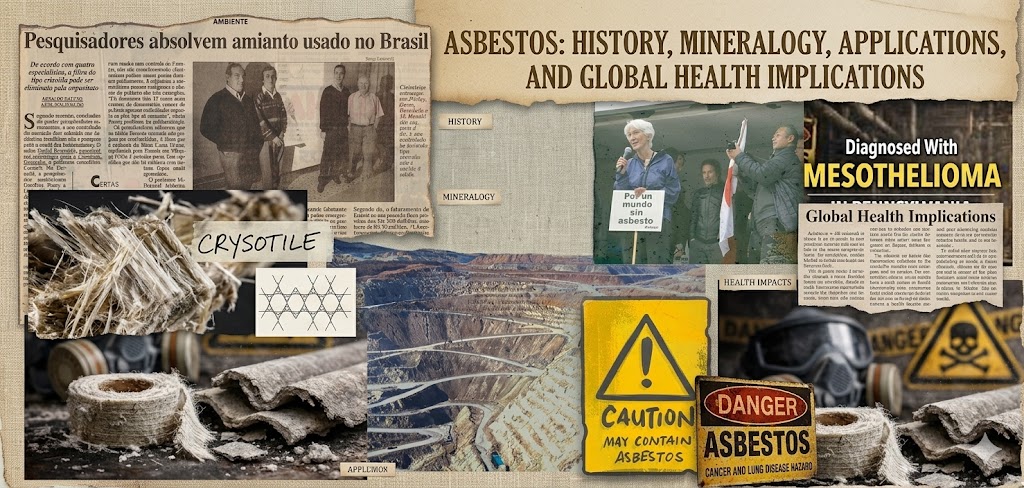
Summary
Asbestos is a group of fibrous minerals once widely used for their strength, heat resistance, and durability. Although valuable in industrial and construction applications, inhalation of asbestos fibers can cause severe diseases such as asbestosis, lung cancer, and mesothelioma, often after long latency periods. Due to these serious health risks, many countries have banned asbestos and implemented strict management and removal regulations. Today, asbestos remains a significant global health concern, particularly in older buildings and industrial environments.
Table of Contents
Asbestos refers to a group of naturally occurring silicate minerals characterized by their fibrous crystal structure. These fibers are strong, flexible, and resistant to heat, fire, chemicals, and electrical conduction. Because of these properties, asbestos became one of the most widely used industrial materials from the late 19th century through much of the 20th century. Its versatility led to its incorporation into thousands of products worldwide, shaping modern construction and manufacturing practices.
From a mineralogical perspective, asbestos is divided into two major families: serpentine asbestos and amphibole asbestos. Serpentine asbestos is represented almost exclusively by chrysotile, which has curly, layered fibers. Chrysotile accounted for more than 90% of asbestos used globally due to its flexibility and ease of processing. Amphibole asbestos, including amosite, crocidolite, tremolite, actinolite, and anthophyllite, consists of straight, needle-like fibers. These fibers are more biopersistent in the human body and are generally considered more hazardous, although all asbestos types are now recognized as carcinogenic.
The industrial use of asbestos expanded rapidly during the Industrial Revolution. It became a key component in thermal insulation for boilers and pipes, fireproofing materials, roofing products, asbestos-cement sheets, brake pads, clutch facings, gaskets, floor tiles, and protective clothing. In the construction sector, asbestos was valued not only for fire resistance but also for sound insulation, durability, and low cost. As a result, asbestos-containing materials (ACMs) were widely used in residential buildings, factories, ships, schools, and public infrastructure.
Despite its utility, concerns about asbestos-related health effects began to emerge in the early 20th century. Medical studies increasingly linked occupational asbestos exposure to respiratory diseases among miners, factory workers, and construction laborers. The most well-known asbestos-related disease is asbestosis, a chronic and progressive lung condition caused by inhalation of asbestos fibers, leading to scarring of lung tissue and reduced respiratory function. Over time, scientific evidence also established strong links between asbestos exposure and lung cancer as well as malignant mesothelioma, a rare and aggressive cancer affecting the pleura (lung lining), peritoneum (abdominal lining), or, less commonly, the pericardium.
One of the most troubling aspects of asbestos-related diseases is their long latency period. Symptoms may not appear until decades after initial exposure, often 20 to 40 years later. This delay complicates diagnosis, compensation, and prevention efforts, as affected individuals may no longer be aware of their exposure history. Furthermore, even low-level or indirect exposure—such as environmental exposure near asbestos mines or secondary exposure from contaminated work clothing—can increase health risks.
In response to mounting evidence, many governments began regulating asbestos use in the late 20th century. Numerous countries have since implemented complete bans on asbestos mining, importation, and manufacturing. International health organizations, including the World Health Organization (WHO), classify all forms of asbestos as Group 1 carcinogens, meaning there is sufficient evidence that they cause cancer in humans. Despite these measures, asbestos remains present in millions of older buildings, creating ongoing challenges for renovation, demolition, and waste management.
Modern asbestos control strategies focus on risk management rather than widespread removal. When asbestos-containing materials are intact and undisturbed, they may pose minimal risk. However, improper handling, aging, or damage can release fibers into the air. Therefore, strict regulations govern asbestos surveys, encapsulation, removal, transportation, and disposal. Trained professionals, specialized equipment, and controlled environments are essential to minimize exposure during remediation activities.
Today, asbestos stands as a powerful example of how materials once celebrated for technological advancement can later reveal profound public health consequences. Ongoing research, education, and policy development aim to prevent future exposure while addressing the legacy of past asbestos use. The global effort to eliminate asbestos-related diseases highlights the importance of precaution, scientific evaluation, and ethical responsibility in material innovation.